News
Yulia Navalnaya Speaks at Kristiansand European Conference
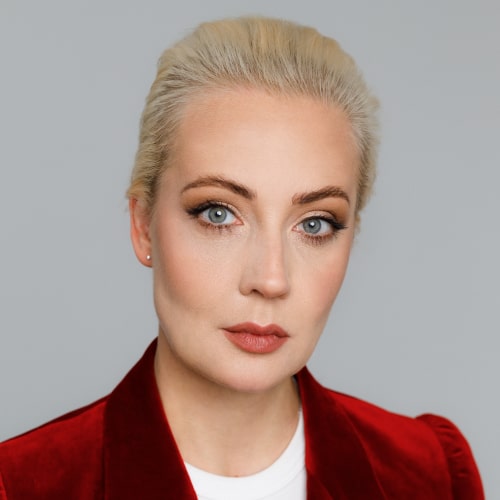
Yulia Navalnaya delivered a keynote address at the Kristiansand European Conference on Democracy and Human Rights in Norway. The central theme of her speech was a vision for the country’s future after regime change.
Navalnaya has been consistently working to ensure that Russia’s democratic movement has a clear reform plan and is able to act quickly in a political crisis when Putin leaves power.
Democracy under pressure – courage, resistance and responsibility
Dear Minister Eide,
Dear President Bayr,
Ladies and gentlemen,
Thank you for the invitation to speak today at this important European conference on democracy and human rights hosted by the Council of Europe.
We are gathered here as representatives of European countries united by shared values — the rule of law, human rights, and democracy.
And we are doing this in Norway — a country that for three years in a row has ranked first in the Economist’s democracy index as the most democratic country in Europe and in the world.
I checked: Norway scores 9.81 out of 10.
My home country, Russia, just 2.03. That places it 155th out of 167.
Even though our countries are neighbors.
It seems that a conference on democracy cannot help Norway become more democratic — there is simply nowhere further to go. And sadly, no conference on democracy can help Russia right now. It has gone too far. I hope everyone in this room understands: there can be no gradual democratization, no “thaw” in Russia, as long as Vladimir Putin — a war criminal, terrorist, and murderer — remains in power.
The chances for change in Russia will only appear after the collapse of his regime. After the war he started ends.
So what should we discuss at this conference? What can we do here, in this room? Let me share a few thoughts.
The country where I was born,The country whose passport I show when I travel,The country whose citizens I represent on European platforms —is, unfortunately, also the only country in the last 50 years that has left the Council of Europe
In this sense, I see your invitation to speak here as a sign of hope.
Hope that this is not forever, that one day Russia will again become a full member of the European political family and rejoin the European Convention on Human Rights.
Let me assure you:
this hope matters a lot to tens of millions of people in my country.
I know this well, because an important part of my work is staying in touch with them — despite censorship, repression, and restrictions.
I know that for most Russians, European values, European ways of life, and European institutions are not empty words.
I also know that there is no such thing as “a people incapable of democracy”. History has proven this many times — with two Germanys and two Koreas.
It has also been proven by Eastern European countries that became democratic after decades under communist regimes.
But I also know that very few people believe in a democratic future for Russia today.
The war against Ukraine has been a terrible shock. The pain is too deep, and it has not stopped for more than four years.
And people still remember how a short democratic period 30 years ago quickly turned into a full dictatorship.
That's why so many people say that it won’t work.After Putin, there will be another Putin.There is something in Russia that prevents it from becoming a normal democratic country.
But is that really true? What actually makes democratic development stable?Why did countries like the Czech Republic, Estonia, and Romania succeed, while Russia did not?
I believe a key factor was the help from Western Europe in building institutions.
Scandinavian countries helped the Baltic states.
The European Union took strong steps to integrate Eastern European countries into a common economic space, open markets, and allow free movement.
But most importantly, they supported the building of institutions.And the Council of Europe played a major role here — Eastern European countries joined it quickly between 1990 and 1993.
The economic difficulties they faced in the 1990s were huge.
But the institutions they built prevented an authoritarian comeback. They acted as safeguards.
Recently, we saw a very hopeful example of how these mechanisms work in Hungary.
Viktor Orbán showed clear authoritarian tendencies and tried to control political institutions.
But democratic institutions proved stronger — because they were already established, and because they were required for membership in the Council of Europe and the European Union.
From this, I draw a conclusion:
Russia will have another chance to choose a democratic path.
Whether that attempt succeeds will depend on the strength of its institutions.
They will need to be built quickly — and this will require active support from all of Europe.
Let me say a few words about the practical work we are doing.
In just one week, for the fourth time, leading Russian experts — sociologists, lawyers, economists, political scientists — will gather in Vilnius at a forum that my team and I organize twice a year.
It is called the “Platform of a Future Russia”.
This is not a conference of speeches.
It is 48 hours of intense workshops and brainstorming.
We bring together top experts, divide them into groups, give them specific tasks to design reform programs for Russia — and do not let them leave until they come up with solutions.
We publish the results every time.
When I first launched this forum two years ago, many were skeptical.
They said: there is a war, there are no prospects for democracy in Russia.
What is the point of discussing local government reform? Or judicial reform?
But we did not agree — and I believe we were right.
Yes, this is a very difficult time to talk about Russia’s future.A kind of ice age for democratic hopes.And very little can be done inside the country when people are imprisoned for a single wrong word.
But this is exactly the time to build the foundations for future institutions.
Because when the window for democratization opens — and it will — we will need to act quickly and decisively. Only then will we have a chance for change.
And that means the plan must be ready now.
Not only the plan — but also the people who will carry it out.
Where will they come from?
Since the start of the full-scale war, more than 220,000 students have left Russia to study abroad, mostly in Europe.
I believe these young people, with strong education and experience in democratic societies, can help build a new Russia.
Many of them will want to return when the time comes to make their motherland a peaceful, free, and prosperous country.
That is why we also invite students to our forums.
They work with experts, take part in discussions, ask questions, and become part of the reform program they will one day help implement.
My biggest fear — I want to say this honestly — is that we are not doing enough.That there will not be enough resources.
That change in Russia will begin suddenly — as it often does — and we will not have enough people, strength, or time to build the institutions needed to prevent a return to authoritarianism.
So today, from this stage, I want to make a simple appeal: Help. Help right now.
Contributing to a plan for Russia’s future, and building a reserve of people who can carry out change — is one of the most important investments we can make today for peace, freedom, and prosperity in Europe.
There is a Russian saying: In winter get your cart ready, in summer your sledge And in Norwegian there is a similar one: «Bedre føre var enn etter snar».
Our cultures are, in the end, quite similar.
A peaceful and democratic Russia is a dream that unites us all.But dreaming is not enough.
We must actively work to make this dream come true.Right now.
There will be no other time.
Yulia Navalnaya